How Lead Capture Tools Turn Website Visitors into Customers
A practical guide for service business owners on how to use lead capture tools to turn website visitors into leads.
Introduction
One of the most common things I hear from service business owners is some version of this: people are visiting my website but nothing is happening. No calls, no form submissions, no inquiries. Just traffic that goes nowhere.
Most of the time the problem is not the traffic. It is that the website has no system for capturing it.
How Lead Capture Tools Turn Website Visitors into Customers
What Is a Lead Capture Tool?
A lead capture tool is anything on your website that gives a visitor a way to take the next step and give you their contact information. It is the mechanism that turns a passive browser into an active prospect.
Without at least one lead capture tool on your site, you are essentially running a billboard. People see it, maybe they like it, and then they drive past and forget about you. With the right tools in the right places, that same visitor becomes a name in your inbox.
The goal is not to trap people or pressure them into giving you their information. It is to make it genuinely easy for someone who is already interested to raise their hand and say they want to hear more.
The Most Effective Lead Capture Tools for Service Businesses
Not all lead capture tools work equally well for service businesses. Here are the ones that consistently deliver results.
Contact and Quote Request Forms
A simple contact form is the foundation of every service business website. It should be short, specific, and placed where people are most likely to be ready to reach out.
The biggest mistake most businesses make with contact forms is making them too long. Name, email, phone number, and one qualifying question is all you need to start a conversation. Every additional field you add reduces the number of people who complete it.
The form also needs to be in the right place. A contact page alone is not enough. Every service page should have a form or a clear link to one. The moment a visitor decides they are interested is the moment you need to make it effortless to act on that interest.
Booking and Scheduling Tools
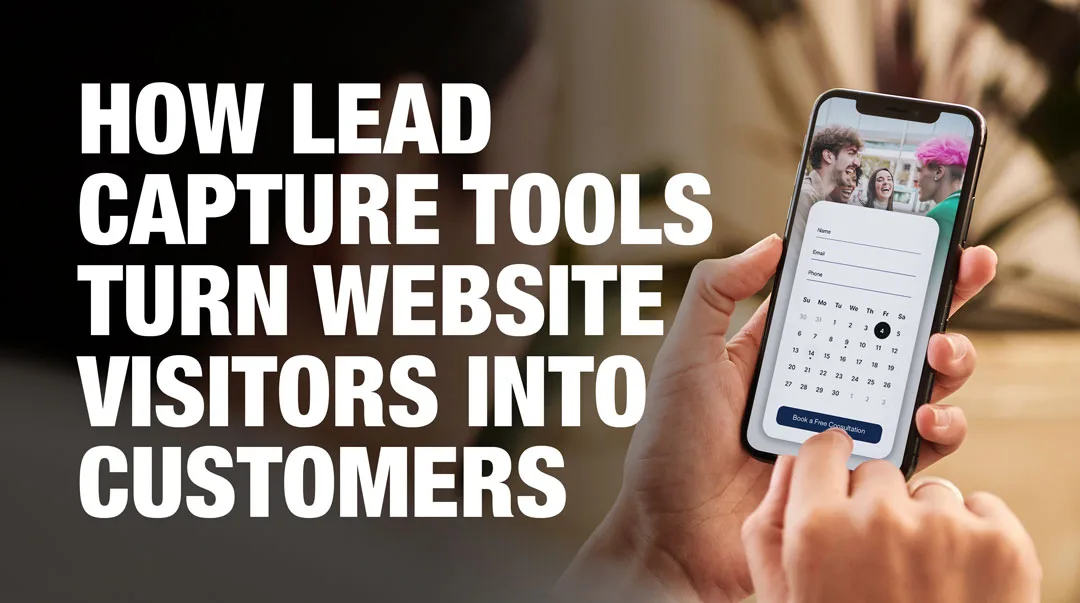
For service businesses that sell their time, a direct booking tool is often the highest converting lead capture option available. Instead of asking visitors to fill out a form and wait for a response, you let them book a call or consultation directly on your site.
Tools like Calendly, GoHighLevel, and Cal.com integrate directly into Webflow and remove the back and forth of scheduling entirely. A visitor goes from interested to booked in under two minutes.
The key to making booking tools work is placement and framing. Do not just add a calendar link at the bottom of your contact page. Put a "Book a Free Consultation" button in your navigation, in your hero section, and after every service description.
Lead Magnets
A lead magnet is a free resource you offer in exchange for an email address. For service businesses, the most effective lead magnets are things that solve a specific problem your ideal client is already trying to solve.
Good lead magnet examples for service businesses include a checklist, a short guide, a template, or a self-assessment tool. The key is being precise. A "Free Website Audit Checklist for Service Businesses" will outperform a generic "Free Marketing Guide" every time because it speaks directly to one specific person with one specific problem.
Lead magnets work best when they are placed contextually. If someone is reading a blog post about website redesign costs, a lead magnet offering a website audit checklist is perfectly timed and highly relevant.
Chat and Chatbot Tools
Live chat and automated chatbots have become increasingly effective for service businesses that get consistent website traffic. They capture visitors who are interested but not quite ready to fill out a form or book a call.
A simple chatbot that asks one question, something like "What brings you to our site today," and then offers to connect the visitor with the right resource or schedule a call, can capture leads that would otherwise leave without taking any action.
The important caveat is that chatbots only work if someone is actually going to respond. If you set up a live chat tool and then go dark for 48 hours, you are doing more damage than good. Either use a fully automated chatbot that sets expectations clearly or make sure you can actually respond within a reasonable timeframe.
Where Most Businesses Go Wrong With Lead Capture
Having lead capture tools on your site is not enough. How and where you use them matters just as much as which tools you choose.
Hiding the form on the contact page only. If the only way to reach you is through a buried contact page, most visitors will never find it. Every page on your site should have an obvious next step.
Asking for too much too soon. A form that asks for your name, company, phone, email, budget, timeline, and project description before you have established any trust will convert poorly. Start with the minimum information needed to have a conversation.
No follow up system. A lead capture tool without a follow up process is just a form that collects data. The moment someone submits a form or books a call, there should be an immediate automated confirmation email and a personal follow up within 24 hours. If you are not following up fast, you are losing leads to competitors who are.
Generic CTAs. A button that says "Submit" or "Contact Us" gives visitors no reason to act. A button that says "Get My Free Website Audit" or "Book a 20 Minute Strategy Call" tells them exactly what they are getting and makes the action feel low risk and worthwhile.
How to Know If Your Lead Capture Is Working
Set up goal tracking in Google Analytics for every form submission and booking on your site. This tells you exactly how many visitors are converting into leads and which pages are driving the most conversions.
The number to watch is your conversion rate. The percentage of visitors who take a lead capture action. For a service business website, a healthy conversion rate is typically between 2% and 5% of total visitors. If your rate is below 1%, there is a lead capture problem worth addressing.
Look at which pages are getting the most traffic and check whether those pages have a clear lead capture mechanism. High traffic pages with no lead capture tool are the most common and most fixable source of lost leads on service business websites.
What to Take Away From All of This
Traffic without a lead capture system is just noise. The businesses that consistently generate leads from their websites are not necessarily the ones with the most traffic. They are the ones that have made it genuinely easy for interested visitors to take the next step.
Start with one thing. If you do not have a contact form on every service page, add one today. If you do not have a booking tool, set one up this week. Small improvements to your lead capture system compound quickly and the results are measurable within days not months.