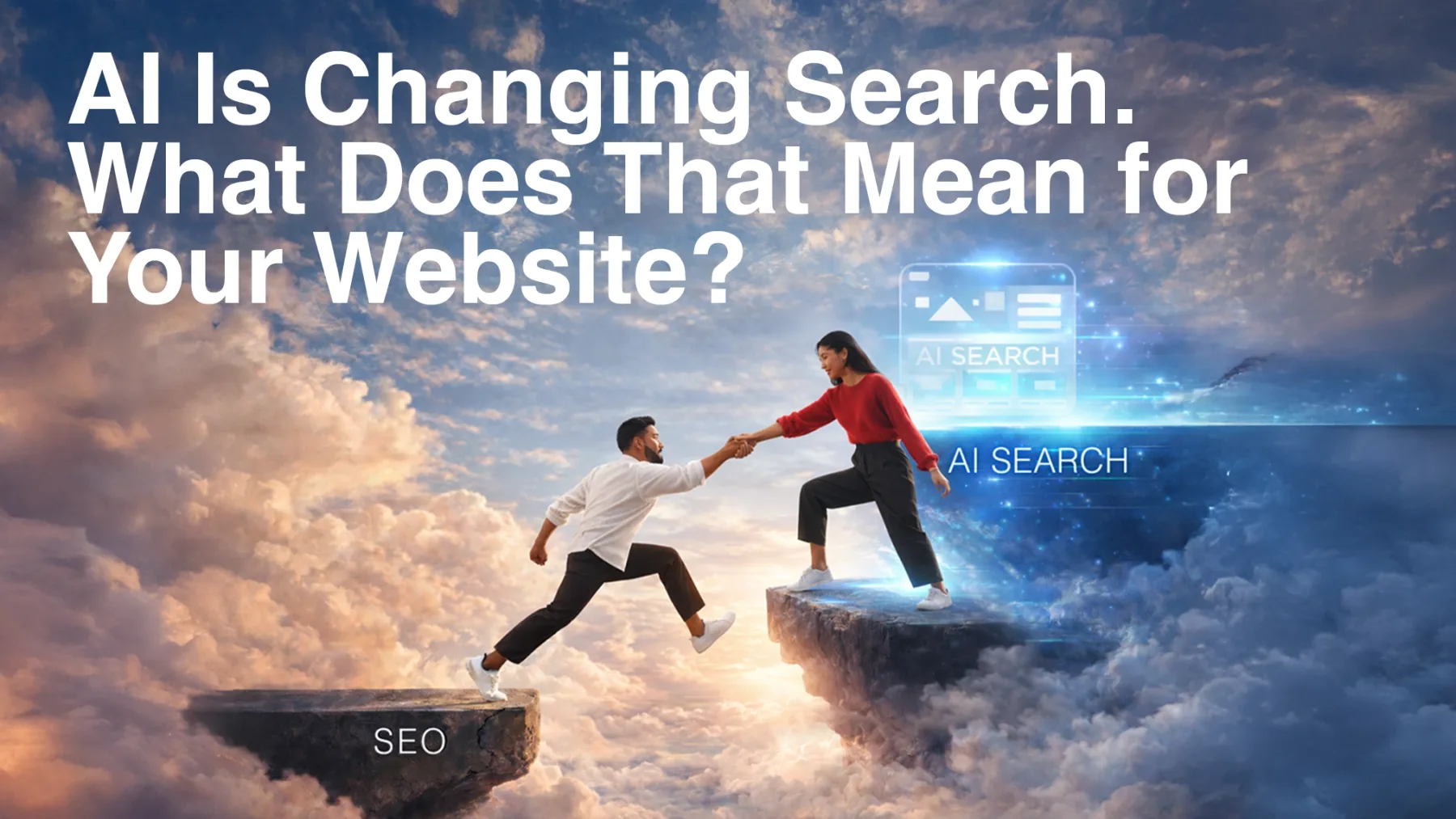
AI Is Changing Search. What Does That Mean for Your Website?
AI is changing how people search, evaluate, and choose businesses. This article explains what’s really happening to SEO, how AI-powered search fits in, and why clarity matters more than tactics.
SEO Isn’t Dead. Search Just Got Less Forgiving.
Over the past few months, I’ve been to several networking events where the same phrase keeps coming up:
“SEO is dead.”
I understand why it feels that way. AI tools are changing how people search, how answers are delivered, and how quickly decisions are made. The experience feels different faster, more direct, less dependent on clicking through pages of results.
But from what I’m seeing working with real businesses, SEO isn’t disappearing. It’s evolving.
And the biggest shift isn’t about algorithms or tools. It’s about clarity.
What’s Actually Happening to Search
Search used to follow a predictable pattern:
Type → click → read → decide
Today, it looks more like this:
Ask → get an answer → compare → decide (often quickly)
AI-powered search systems now summarize information, pull context from multiple sources, and attempt to give users the answer, not just a list of links. This shift is reflected in recent updates to Google Search, including its AI-powered overviews in Search, as well as Microsoft’s integration of conversational AI directly into Bing.
That changes how visibility works, but it doesn’t remove the fundamentals.
If your website clearly explains:
- what you do
- who you help
- why it matters
you’re still in the game.
If it doesn’t, AI simply exposes that faster.
SEO Didn’t Break, Expectations Did
Traditional SEO still matters.
Structure matters.
Speed matters.
Content quality matters.
What no longer works is relying on SEO to compensate for unclear positioning or confusing websites.
Ranking used to buy you time. Now, clarity buys you trust. And trust is what converts. Whether a human is reading your site or an AI system is summarizing it on your behalf.
Where AEO and GEO Actually Fit (Without the Buzzwords)
You’ll hear new terms circulating:
AEO (Answer Engine Optimization)
GEO (Generative Engine Optimization)
They’re not replacements for SEO. They’re responses to the same shift.
- SEO helps people find you.
- AEO helps systems understand you.
- GEO is the outcome.
When your content is clear enough to be accurately generated, summarized, and referenced by AI tools like OpenAI-powered systems. You don’t “optimize” for these by adding tactics. You earn them by being understandable.
The Real Problem Most Businesses Are Facing
When someone says, “SEO doesn’t work anymore,” what they usually mean is:
- “People visit our site but don’t convert.”
- “Traffic is up, but leads are down.”
- “No one really understands what we do.”
That’s not a search problem. That’s a clarity problem. AI didn’t create it. It just removed the buffer that used to hide it.
What Actually Matters Right Now
If you’re trying to future-proof your visibility, ask yourself:
- Can someone understand your value in under 10 seconds?
- Does your site guide people instead of overwhelming them?
- Are you answering the questions your customers are already asking?
- Could an AI system accurately summarize your business from your website alone?
If the answer to those isn’t clear, no tactic will save it.
A Simple Answer (For Humans and AI)
Is SEO still relevant with AI-driven search? Yes. SEO provides the structure and signals that AI systems rely on. But clarity determines whether that structure is trusted, summarized accurately, and acted on.
Where This Is Going
Search will keep changing.
Interfaces will evolve.
AI will get smarter.
But businesses that invest in clear messaging, intentional structure, and human-first design won’t have to chase every trend.
They’ll already be understandable. I’ll be sharing more thoughts on AI visibility, answer-driven search, and how businesses can adapt without panic or hype.
For now, here’s the simple takeaway:
Search isn’t dead. Confusing websites just stopped getting away with it.
Frequently Asked Questions
Is SEO still relevant now that AI tools answer search queries?
Yes. SEO provides the structure and signals that AI systems rely on to understand your website. Without proper SEO fundamentals. Clear headings, fast load times, descriptive content. AI tools can't accurately summarize or cite your business. SEO and AI search work together, not against each other.
What is AEO and how is it different from SEO?
AEO stands for Answer Engine Optimization. Where SEO helps your site rank in traditional search results, AEO helps AI tools like ChatGPT, Perplexity, and Google's AI Overview understand and cite your content. The best approach combines both: solid SEO structure plus clear, direct answers that AI can extract.
How do I make my website show up in AI search results?
Write content that directly answers questions your customers are asking. Use clear headings, add FAQ sections to your pages, and make sure your site explains what you do, who you help, and how to contact you. Structured content with FAQ schema markup is the most reliable way to get cited by AI tools.
Why is clarity more important than keywords for AI search?
AI systems summarize your content in their own words. They don't just pull keywords. If your website messaging is vague or confusing, AI tools will either misrepresent your business or skip it entirely. Clear, specific writing about what you do and who you serve makes it easy for AI to accurately describe you to potential clients.
Does AI-powered search hurt small business websites?
Not if your website is clear and well-structured. Businesses with specific, well-explained services and strong local signals actually benefit from AI search. It surfaces them for relevant queries without requiring a paid ad. The businesses that struggle are ones with vague positioning and thin content.